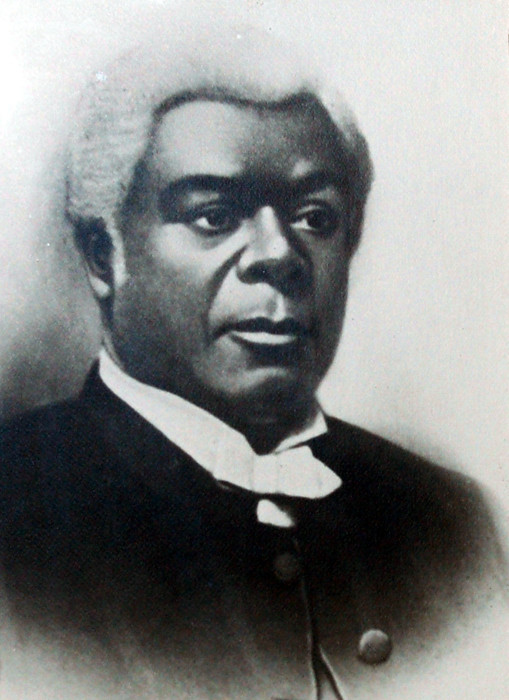
8th Bishop
Jabez Pitt Campbell
After serving as editor of The Christian Recorder and pastoring Mother Bethel, Jabez Pitt Campbell was elected the eighth bishop of the AME Church in 1864. As bishop, he established the Louisiana and California conferences in 1865, carrying the AME Church into the South and West after the Civil War.
- Birth Date: February 5, 1815
- Consecration Date: May 16, 1864 (served 30 years)
- Death Date: August 9, 1891
-
Spouse: Stella Medley (m. October 23, 1844; d. April 1854)
Mary Ann Shire (m. June 7, 1855)
BACKGROUND: Bishop Campbell was born free in Slaughter Neck, Sussex County, DE, on February 5, 1815. Both his grandfathers were soldiers during the Revolutionary War, a rare occurrence, as there were only about 5,000 African Americans in the Continental Army. His father was Anthony Campbell, a Methodist preacher, and his mother was Catherine Campbell; both were members of the AME church. When Campbell was young, his father used him as collateral for a loan and left without paying it, putting Jabez at risk of being sold. This would lead to Campbell running away toward Pennsylvania to avoid being enslaved. Despite his efforts, Campbell was sold for a term of service; after serving four and a half years, he purchased the remaining two years of his time from his master, becoming his own master at age eighteen — driven, in his own words, by “an insatiable desire for a good education.” He married twice. His first marriage was to Stella Medley, on October 23, 1844; they had one child, Catherine Stella Campbell, born in 1852. Stella died in April 1854. His second marriage was to a widow by the name of Mary Ann Shire, on June 7, 1855, who had four children from her previous marriage. Campbell and Mary would have no children together. Campbell and his wife Mary held life memberships on the Board of Managers of the Home for Aged and Infirm Colored Persons in West Philadelphia. He would die in Philadelphia on August 9, 1891, and funeral rites were held at Bethel Church at Sixth and Lombard, after which he was buried at Olive Cemetery in Philadelphia.
THEOLOGY: In 1833, Jabez Campbell joined Bethel Church in Philadelphia. Bishop Campbell was licensed to preach by Bishop Morris Brown at Bethel Church in Philadelphia. In 1840 he was sent to New England, where he was admitted to the New York Conference. He was ordained a deacon by Bishop Brown in Providence, RI, in 1841, and ordained an Elder by Bishop Brown in 1843. Some of his appointments were: Bucks Co., Bethel in Philadelphia, PA, Providence and New Bedford, New England, Albany, Hudson, Buffalo, and Bethel again, followed by pastorates in Baltimore and Philadelphia. He continued his pastoral service, including his tenure at Mother Bethel from 1862 to 1864, until May 1864, when he was elected the eighth bishop of the AME Church. As a new bishop, he established the Louisiana and California conferences in 1865, extending the denomination’s reach after the Civil War. In 1887, presiding over the North Carolina Annual Conference, Campbell ruled against the ordination of Sarah A. Hughes, the first woman ordained a deacon in the AME Church, removing her name from the conference’s list of deacons — a position consistent with the church’s 1888 General Conference resolution barring bishops from ordaining women to the diaconate or eldership.
Honors and Awards
- Awarded an honorary degree of Doctor of Divinity by Wilberforce University.
- Awarded an honorary Doctor of Laws degree by the University of Pennsylvania.
Achievements
- General Book Steward and Editor of the Christian Recorder, 1856-1858.
- Fraternal Messenger of the AME Church to the Wesleyan Methodist Church, England, in 1879.
- President of the Trustee Board for Wilberforce Choir, 1883-1891.
- President of the General Board of Education, 1884.
- Elected Vice President of the American Colonization Society, 1876.
- Contributed financially to Wilberforce University and to Jabez Pitt Campbell College, later absorbed into what is now Jackson State University.
- One of only four editors of The Christian Recorder to go on to become an AME bishop — the first of the four, chronologically, to do so.
SOURCES
African American Registry. “Jabez Campbell, Minister, and Abolitionist Born.” Accessed August 10, 2026. https://aaregistry.org/story/jabez-campbell-born/.
BlackPast.org. “A.M.E. Christian Recorder (1848– ).” Accessed August 10, 2026. https://blackpast.org/african-american-history/groups-organizations/a-m-e-christian-recorder-1848/.
The Christian Recorder. “A Brief History of The Christian Recorder.” Accessed August 10, 2026. https://www.thechristianrecorder.com/history/.
Colored Conventions Project. “Bishop Jabez Pitt Campbell.” Mural Arts Biographies. University of North Carolina. Accessed August 10, 2026. https://coloredconventions.org/mural-arts/biographies/bishop-jabez-pitt-campbell/.
Colored Conventions Project. “Jabez P. Campbell.” The Fight for Black Mobility: Traveling to Mid-Century Conventions. University of North Carolina. Accessed August 10, 2026. https://coloredconventions.org/black-mobility/delegates/jabez-p-campbell/.
Cultural Tourism DC. “Campbell African Methodist Episcopal Church.” Historical Marker Database. Accessed August 10, 2026. https://www.hmdb.org/m.asp?m=33749.
Kiddle Encyclopedia. “Learn Jabez Pitt Campbell Facts for Kids.” Accessed August 10, 2026. https://kids.kiddle.co/Jabez_Pitt_Campbell.
New York Public Library Digital Collections. “Rt. Rev. J. P. Campbell, Eighth Bishop A. M. E. Church.” Schomburg Center for Research in Black Culture. Accessed August 10, 2026. https://digitalcollections.nypl.org/items/510d47da-7651-a3d9-e040-e00a18064a99.
Wikipedia. “African Methodist Episcopal Women Preachers.” Accessed August 10, 2026. https://en.wikipedia.org/wiki/African_Methodist_Episcopal_women_preachers.
Wikipedia. “Jabez Pitt Campbell.” Accessed August 10, 2026. https://en.wikipedia.org/wiki/Jabez_Pitt_Campbell.
Wright, Richard R. Centennial Encyclopaedia of the African Methodist Episcopal Church. Philadelphia: Book Concern of the A.M.E. Church, 1916. Quoted in Colored Conventions Project, “Jabez P. Campbell.”