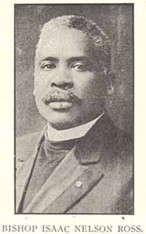
41st Bishop
Isaac Nelson Ross
- Birth Date: January 22, 1856
- Consecrated: 1912
- Death Date:
Isaac Nelson Ross, 41st bishop of the African Methodist Church, was born January 22, 1856, in Hawkins County, East Tennessee. In 1861 his parents moved to Green County, Ohio, with ten children. His father was a sturdy, painstaking, thrifty farmer, a man of sobriety and integrity. His mother was a woman of strong personality and Christian piety. Four of the five sons of the Christian parents became ministers of the A. M. E. Church.
Rev. W. P. Ross was founder of the Divinity High School, now Edward Waters College. Rev. O. P. Ross, at the time of his death, was dean of Campbell College, Jackson, Miss. Rev. A. H. Ross was one of the founders of Wayman Institute, of Harrodsburg, Ky., and at the time of his death, was the Chairman of its Trustee Board.
Bishop I. N. Ross is the youngest and only surviving member of the well known quartette of “Ross” preachers. He received his early school training in his home town, Bowersville. His early life was spent in work on the farm, when he was not in school.
On January 1, 1879, he was married to Miss Mary Robinson Fletcher of Elizabethtown, Harding County, Ky. Six children, four of whom are living, blessed this union. The oldest son is a practicing physician in Cincinnati. The oldest daughter, who is a graduate of the University of Cincinnati, is a teacher in the public schools there. The youngest daughter, who is a graduate of the Teachers’ College of Howard University, Washington, D. C., is a Kindergarten teacher in Cincinnati; and the youngest son, of the Physical Culture Department of Harvard University, Cambridge, Mass., is a professor of physical culture in the public schools of Cincinnati.
Dr. Ross joined the Ohio Conference in 1880 and pastored the following churches: Oberlin Mission, O.; St. Paul’s A. M. E. Church, Washington, Pa.; Oil City and Titusville Circuit, Pennsylvania; Brown’s Chapel, Allegheny City, and Wiley Avenue A. M. E. Church, Pittsburgh, Pa.; Warren Chapel, Toledo, Ohio; St. Paul’s Church, Columbus, Ohio, where he entertained the general conference in 1900; 5 years at Allen Temple, Cincinnati, Ohio; 3 years and 6 months at Big Bethel, Atlanta, Georgia, and 4 years and 9 months at Metropolitan A. M. E. Church, Washington, D. C., 2 years at Ebenezer, Baltimore, until May, 1916. All of these churches have been financially and spiritually quickened and improved. Some of them were relieved of their heavy indebtedness. Most prominent among those relieved were Brown Chapel, Allegheny City, where a mortgage debt of $3,858.00, of 27 years’ standing, was entirely lifted and the mortgage burned. A sinking fund was created at Wiley Avenue A. M. E. Church for the building of a new church. A new site was purchased at Titusville. The church was moved-from a back street to one of the main streets of the town. Brown Chapel, Oil City, was made almost new. The church at Toledo was paid entirely out of debt. The indebtedness of St. Paul’s Church was changed and arranged so as to make it practical to meet the obligations as they came due, and the church at Cincinnati was improved and remodeled on the interior, completely from top to bottom, fitted up with all modern appliances at an expense of several hundred dollars, which was paid off as the work advanced. At Big Bethel Church, Atlanta, Ga., his work as pastor was marked all the way with consecration and seriousness; thousands of dollars were paid on the indebtedness; the basement, which had been untouched from the time of the erection of the church, was put in excellent condition for regular use, electric lights were installed and renovated and the interior remodeled. At Metropolitan A. M. E. Church he installed steam heat and made other needed improvements on the interior and exterior of the church; reduced its bonded debt $2,000, and greatly increased the congregation.
He was a delegate to the general conferences of 1892 to 1908, and is a delegate to the Centennial General Conference of 1916. In 1912 he received a large vote for the bishopric. He was one of the most popular pastors of the A. M. E. Church. He received “D. D.” from Wilberforce in 1903. He was elected bishop on the third ballot to the bishopric May 18, 1916.
Ross, Mamie Robinson Fletcher, wife of Bishop I. N. Ross, was born in Elizabethtown, Ky., six years before the war which marked the close of slavery. When a babe she was given as a bridal present to a young lady in the family in which her mother had served faithfully. Being in a good family and so young, she escaped the horrors and cruel treatment to which many slaves were subjected. After the war she went to a little cottage to live with her mother and brother. She attended the school established in her town. She grew up into a much-respected young lady. Her pastor introduced her to his brother, the Rev. I. N. Ross, whom she married later and early in her twenties. She has served faithfully with him from the small mission to the bishopric. Mrs. Ross was always closely identified with the missionary societies of the churches which her husband served. Beginning at Cincinnati, she started a chain of societies known as “The Lend-a-Hand Association of Ministers’ Wives.” Another plan she adopted is that of gathering the new women members of the churches and getting them in line to help the church in an organization known as “The Willing Workers.” Both of these organizations are doing good work in the various communities in which she planted the seed. Mrs. Ross is also an enthusiastic member of the National Association of Colored Women’s Clubs. Although deprived of a regular and complete education, she has read good books, subscribed to helpful magazines, attended lectures and conventions, traveled considerably, and is known and loved wherever she has worked.
Information taken from Centennial Encyclopedia of the AME Church by Richard R. Wright, 1916, pps. 191 – 193.